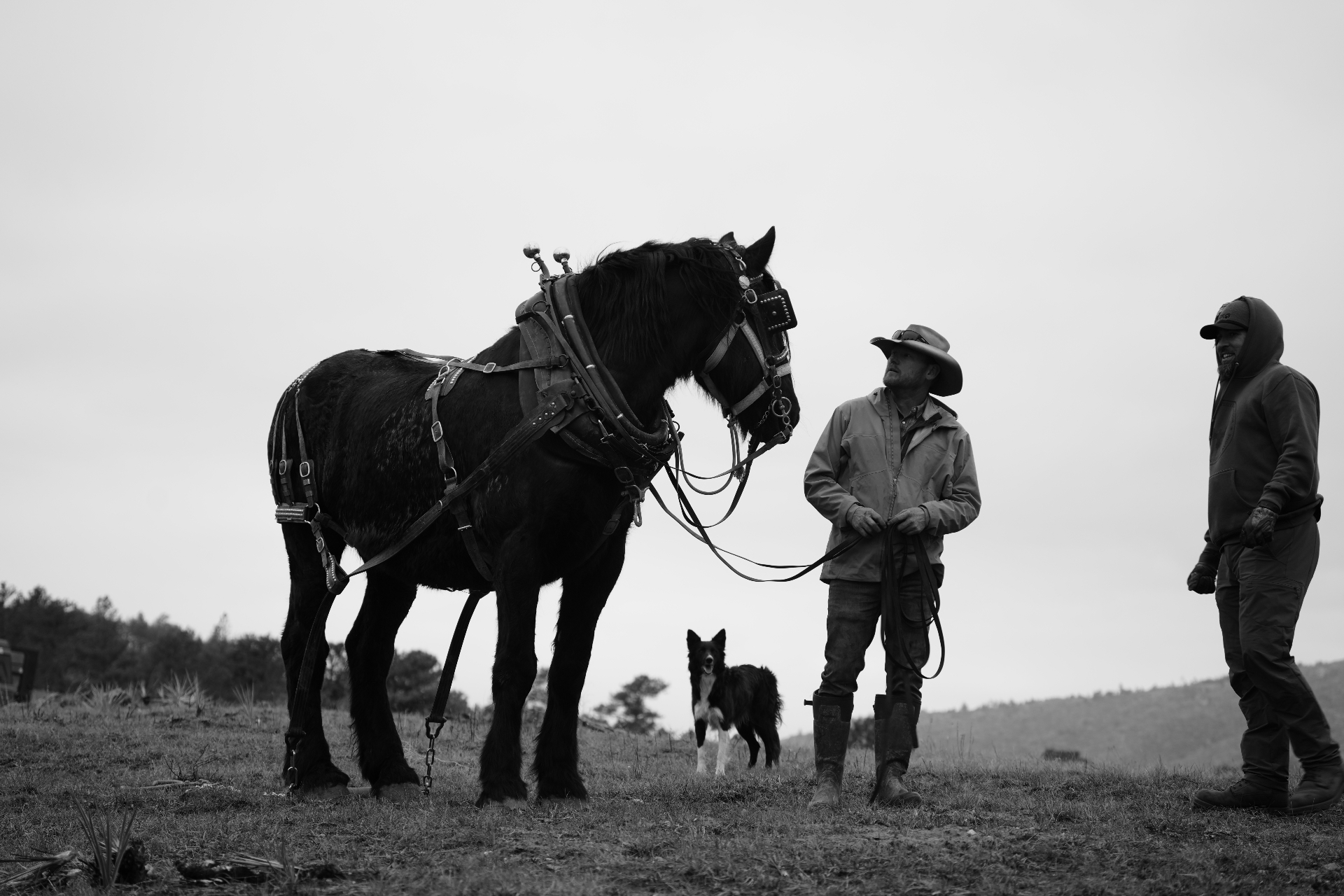
Working horses in harness at Sylvan Dale Ranch
← H.O.L.L.S.Founding Certificate Program · Launching January 2027

Colt Starting & Ranch Horsemanship

A 12-week, 390-hour program in starting and handling horses under direct supervision.

Program Length
12 weeks
Clock Hours
390 hours
Instructional Days
Mon-Fri
Tuition
$24,000
Daily Schedule
9:00 AM to 5:00 PM
Location
Sylvan Dale Ranch · Loveland, CO
Hand on a colt's face in golden light
Course Description

Safety, consistency, and observable results

The Colt Starting & Ranch Horsemanship Certificate is a clock-hour, instructor-supervised occupational training program built to prepare students for entry-level work with horses in ranch and working environments. Instruction is facility-based. There is no externship, no independent study, and no off-site training.

The curriculum is phased. Classroom technical briefings, instructor demonstration, and guided observation lead into progressive hands-on practice across multiple horses. Emphasis stays on observable horse response, safe handling, and task sequencing that reflects real ranch operations.

Learning is competency-based and evaluated through performance and horse response rather than written exams. Successful completion means a student has demonstrated the competencies to perform supervised horse starting and ranch horsemanship tasks in an occupational setting.

Horses provided. H.O.L.L.S. supplies every horse used in the program. Students rotate through a working string rather than being limited to a single horse, gaining experience with a range of temperaments, ability levels, and problem-solving situations.
Credential. Certificate of Completion: Colt Starting & Ranch Horsemanship (non-degree occupational). Designed in compliance with Colorado Division of Private Occupational Schools requirements and VA education approval standards for non-degree, clock-hour programs.
Learning Objectives

What a graduate can do

Occupational Outcomes
  • Ranch hand with assigned horse-handling and riding responsibilities
  • Assistant horse trainer supporting colt starting and foundational training
  • Working horse handler in ranch, livestock, or agricultural settings
  • Livestock and ranch operations support staff using horses in daily work
  • 01Demonstrate safe facility practices, horse handling procedures, and equipment use.
  • 02Properly approach, halter, lead, and manage horses in controlled and working environments.
  • 03Apply pressure-and-release principles to achieve predictable horse response on the ground and under saddle.
  • 04Safely saddle, tack, and prepare horses for ranch-appropriate riding tasks.
  • 05Demonstrate controlled mounted skills including starting, stopping, turning, and gait transitions.
  • 06Identify and respond appropriately to common horse behavior and handling challenges in ranch settings.
  • 07Maintain safety, consistency, and situational awareness while working with multiple horses.
  • 08Perform assigned horse-handling and riding tasks in accordance with instructor direction and established safety standards.
Phased Curriculum

Three phases. Twelve weeks

Riding time and task complexity increase by phase, based on demonstrated competency. Full detail is in the syllabus.

Phase I · Weeks 1-4

Foundations & Safety

Establish the foundational safety, horse handling, and groundwork skills required for ranch employment.

Skills & Competencies
  • Facility and horse safety procedures
  • Safe approach, haltering, and leading
  • Ground control and positioning
  • Pressure and release fundamentals
  • Introductory riding, late phase only
Monday Focus
  • Farrier basics and horse restraint
  • Safety theory and equipment use
  • Instructor demonstration of groundwork techniques
Assessment
  • Binary competency checks
  • Safety violations require retraining
  • Instructor-verified performance only
Phase II · Weeks 5-8

Control & Consistency

Develop reliable horse response under saddle and consistent handling across multiple horses.

Skills & Competencies
  • Saddling and tack management
  • Mounted control: stop, turn, forward
  • Ranch-appropriate gait transitions
  • Problem response introduction
  • Extended riding duration under supervision
Monday Focus
  • Farrier skill reinforcement
  • Instructor demonstrations of mounted techniques
  • Observation of correction sequences and common errors
Assessment
  • Horse response within defined thresholds
  • Reduced instructor prompting, instructor remains present
  • Task completion and safety compliance
Phase III · Weeks 9-12

Advanced Occupational Application

Prepare students to perform ranch-relevant horse starting tasks independently under supervision.

Skills & Competencies
  • Consistent control across multiple horses
  • Problem response and correction
  • Riding under controlled environmental variability
  • Task sequencing without step-by-step prompts
Monday Focus
  • Advanced farrier handling
  • Demonstrations of job-realistic scenarios
  • Technical briefings and error analysis
Assessment
  • Summative competency evaluations
  • Pass or needs retraining
  • Based solely on observable horse response and safety
Weekly Instructional Cadence

Monday sets the standard. Tuesday through Friday earns it

Monday
Classroom & Farrier

Farrier theory, demonstration, and supervised participation in the morning.

Monday
Technical Briefings

Afternoon instructor-demonstrated applied techniques and technical preparation. No student-led riding.

Tuesday
Practical Rotation

Time-blocked instruction with instructor-assigned horses, 30 to 90 minutes per horse.

Wednesday-Thursday
Supervised Practice

Rotational practical instruction. Riding time increases by phase. Instructor present at all times.

Friday
Applied Ranch Work

Job-realistic tasks, correction sequences, and competency verification through observed performance.

Instructors assign horses and control rotation to protect horse welfare, student safety, and ranch-realistic work conditions. Observation hours are instructor-directed and count as instructional time. Students may not engage in unsupervised horse work.

Admissions

The inaugural cohort starts in January 2027

Tuition is $24,000 and covers instruction. Housing is optional and arranged separately. Admission requires a minimum age of 18 and the ability to participate safely in physically demanding work. Veterans: ask us about VR&E (Chapter 31) eligibility, pending applicable approvals.